

At Ohio University, faculty member Basil Masri Zada has dedicated the past several years to helping develop the coursework for the new concentration in the School of Art and Design, Digital Arts + Technology. This area of study focuses on the constantly developing relationship between technology and art and allows students to develop their own approaches to creating art in an increasingly digital age.
Press Releases
Primary tabs
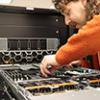
The Ohio Supercomputer Center (OSC) will launch a major new high performance computing (HPC) cluster, Cardinal, in the second half of 2024. The Dell Technologies-based cluster will support the growing need for HPC resources in Ohio for research, education and industry innovation, especially in the area of artificial intelligence (AI).

This year Ohio Supercomputer Center (OSC) staff participated in five large research computing-focused conferences where academic researchers and industry came together to share how they are advancing the high performance computing (HPC) field.
“OSC strategically engages with the national community to bring the best back to Ohio and its universities,” said David Hudak, OSC executive director.

At The Ohio State University, Jessica Cooperstone leads a research laboratory focused on understanding the factors that create the health benefits found in fruits and vegetables, with the aim of helping the agriculture and food industry cultivate crops that improve overall human health.
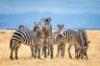
University of Maine scientist Pauline Kamath conducts research on the dynamics of infectious diseases that can spread among wildlife, with the use of the high performance computing (HPC) resources at the Ohio Supercomputer Center (OSC). Kamath, an associate professor of animal health, analyzes genetic, ecological, immunological and epidemiological data to study the evolution and transmission of harmful pathogens in animals to better understand how to treat and control infections.
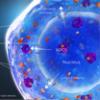
A drug designed to treat a certain type of cancerous tumor might work well in some patients but not others. To determine why, scientists can study whether specific genetic mutations may impact the therapy’s effectiveness.
Karyopharm Therapeutics, a commercial-stage pharmaceutical company pioneering novel cancer therapies, is taking a closer look at these unique molecular characteristics of different cancers with the help of the Ohio Supercomputer Center (OSC).
As a partner of the National Science Foundation-funded Artificial Intelligence (AI) Institute for Intelligent Cyberinfrastructure (CI) with Computational Learning in the Environment (ICICLE), the Ohio Supercomputer Center (OSC) will host the project’s 2023 All Hands Meeting Nov. 2-3.

In 2019, the Milwaukee School of Engineering (MSOE) unveiled a major addition to its campus: the Dwight and Dian Diercks Computational Science Hall, featuring Rosie the supercomputer. The facility opened in the wake of the launch of MSOE’s bachelor’s degree in computer science, with a curriculum focused on the growing field of artificial intelligence.

The Center for Computationally Assisted Science and Technology (CCAST) at the North Dakota State University (NDSU) provides high performance computing (HPC) resources to NDSU and various other institutions within North Dakota. With more than 12,000 CPU cores and 70 GPUs, CCAST is the largest academic supercomputing facility in the state of North Dakota.

National Science Foundation grant will support long-term sustainability plan for OSC's Open OnDemand
The National Science Foundation (NSF) has awarded the Ohio Supercomputer Center (OSC) $1.5 million in funding to create a new governance organization for Open OnDemand, a web portal that provides easy access to high performance computing (HPC) resources, to ensure the long-term sustainability of the project.
