Researchers work to refine calculations of ocean levels
Researchers at The Ohio State University ElectroScience Laboratory (ESL) are using powerful supercomputers to further refine satellite measurements of the surface height of the world’s oceans.

Researchers at The Ohio State University ElectroScience Laboratory (ESL) are using powerful supercomputers to further refine satellite measurements of the surface height of the world’s oceans.
Video HighlightsClick on the links below to view the video demonstrating the new software. "Ohio State University software is helping to forecast traffic accident hotspots. This video shows the software in action. Data visualization/screen capture by the Ohio Supercomputer Center, courtesy of Ohio State University." |
Ralph Regula Media Contacts
Kathryn Kelley, OSC
614/292-6067 or kkelley@osc.edu
Jamie Abel, OSC
614/292-6495 or jabel@osc.edu
Bret Crow, Ohio Board of Regents
614/752-9480 or bcrow@regents.state.oh.us
A school without bricks and mortar promises to transform Ohio's education and workforce.
Four Ohio Supercomputer Center (OSC) employees, as well as two Ohio State University (OSU) plant biology researchers, had a manuscript published in the online journal, Plant Physiology. The manuscript was entitled, “Genome-wide Identification of Arabidopsis Coiled-coil Proteins and Establishment of the ARABI-COIL Database.”
Chemists at The Ohio State University and their colleagues may have settled a 70-year-old scientific debate on the fundamental nature of ice.
A new statistical analysis mechanical theory has confirmed what some scientists only suspected before: that under the right conditions, molecules of water can freeze together in just the right way to form a perfect crystal. And once frozen, that ice can be manipulated by electric fields in the same way that magnets respond to magnetic fields.
Grant funds OSU's Hadad for continued computational chemistry at OSC
Columbus, Ohio (Nov. 14, 2011) – A $7.5 million award will help researchers harness the body’s own defenses to counteract nerve agents and create new types of antidotes for exposure to pesticides and other poisons.
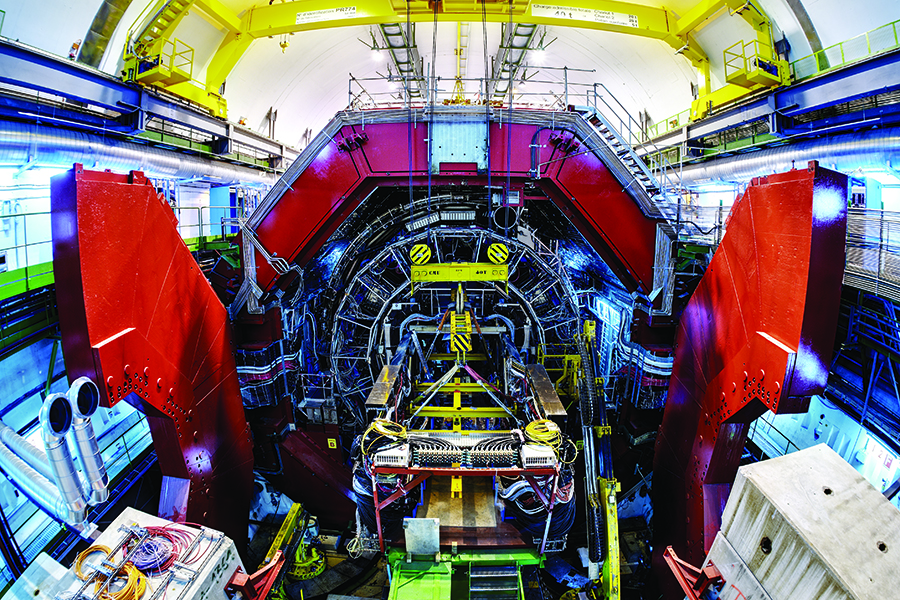 |
| The Large Hadron Collider’s ALICE detector near Geneva, Switzerland. (Photo © CERN) |
Scientists are working to develop a new drug that will regenerate a critical enzyme in the human body that “ages” after a person is exposed to deadly chemical warfare agents.
Christopher Hadad, Ph.D., professor of chemistry at The Ohio State University (OSU), is leveraging Ohio Supercomputer Center (OSC) resources to help develop a more effective antidote to lethal chemicals called organophosphorus (OP) nerve agents.
Algorithm searches for models that best explain experimental data
Columbus, Ohio (Aug. 2, 2011) – A Franklin University professor recently developed an evolutionary computation approach that offers researchers the flexibility to search for models that can best explain experimental data derived from many types of applications, including economics.

Columbus, Ohio (May 16, 2011) - Nimbis Services, Inc. announced the company has been awarded two-year DARPA Phase 2 Small Business Innovation Research (SBIR) Application Domain Portal Hosting Service project.
