
The Ohio Supercomputer Center has launched a major expansion of its Ascend cluster, which provides greater access to graphics processing units (GPUs) for artificial intelligence (AI) and machine learning computation and medical research and education.
Ascend now has eight times the computing power of its previous system, which launched in 2022, as well as a new software and programming environment. The cluster offers shorter wait times, streamlined workflows, and faster computation.
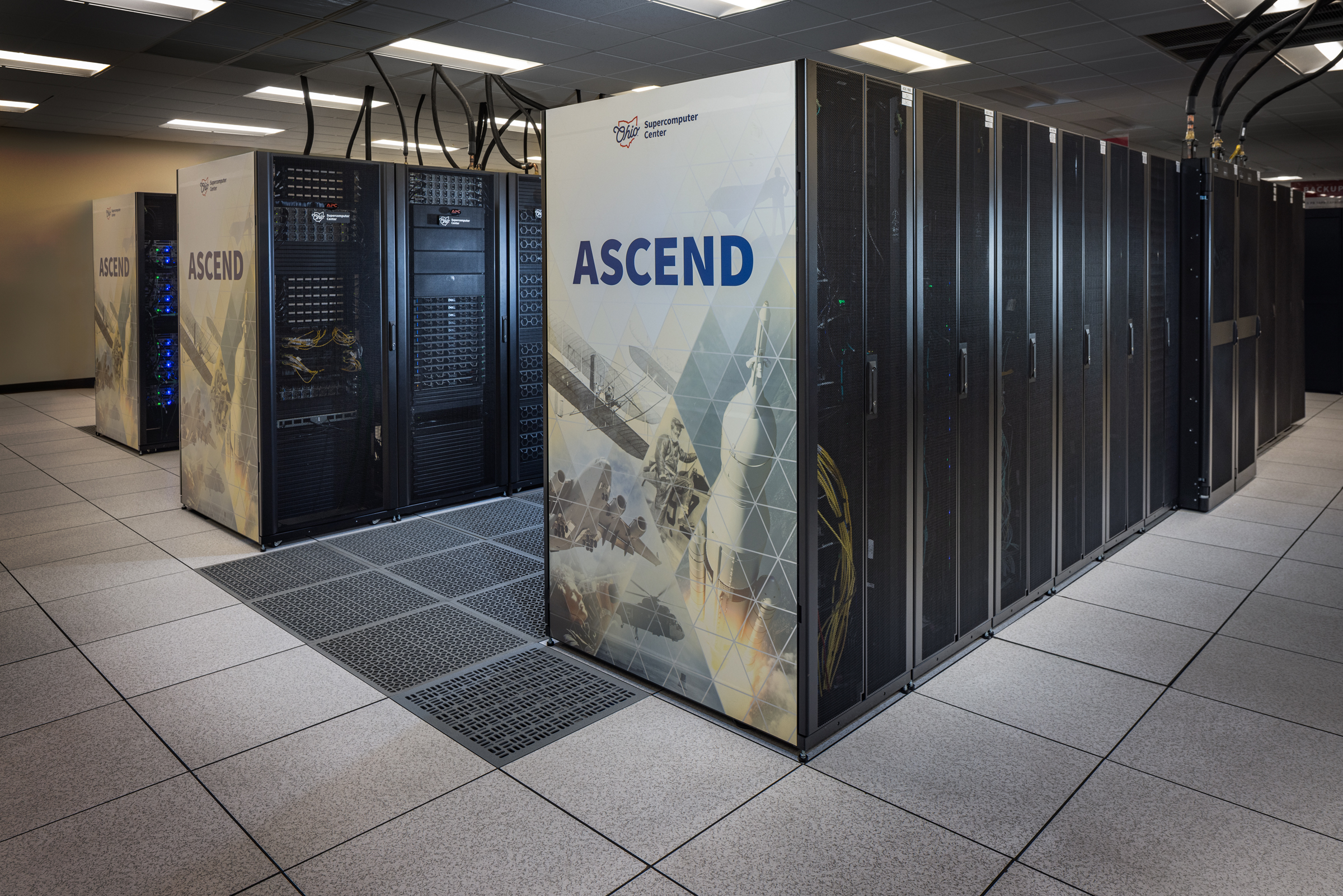
The expansion was made possible by a collaboration with The Ohio State University Wexner Medical Center and The Ohio State University College of Medicine, which transferred ownership of research computing resources to OSC. Through this agreement, affiliated faculty and students will receive priority scheduling and can run jobs at zero cost to them due to the investment by the college. The new Ascend cluster resources are available for all OSC clients to use.
“This collaboration supports medical research and education at Ohio State while providing advanced resources to OSC’s entire client community,” said David Hudak, OSC executive director. “With more clients using our high performance computing clusters for AI, machine learning, and data analysis, GPUs are in high demand. We appreciated this opportunity to work with our colleagues at Ohio State to upgrade and improve our hardware capabilities.”
The next-generation version of Ascend, a ~16 petaflop (PF) system, features 776 GPUs, 40,448 cores, and 322 Dell nodes. The system has three types of nodes:
24 original nodes with:
- Two AMD EPYC 7643 processors, 48 cores each, 96 cores per server
- Four NVIDIA Ampere A100 GPUs, each with 80 GB
- 200 Gbps HDR InfiniBand
- 1TB RAM
214 new dual GPU nodes with:
- Two AMD EPYC 7H12 processors, 64 cores each, 128 cores per server
- Two NVIDIA Ampere A100 GPUs, each with 40 GB
- 100 Gbps HDR InfiniBand
- 0.5 TB RAM
84 new triple GPU nodes with:
- Two AMD EPYC 7H12 processors, 64 cores each, 128 cores per server
- Three NVIDIA Ampere A100 GPUs, each with 40 GB
- 100 Gbps HDR InfiniBand
- 0.5 TB RAM
Detailed system specifications are available on the Ascend cluster webpage.
Watch the build process of Ascend unfold:
The new Ascend cluster resources have made a positive impact on client work.
“Our biomedical research teams are already experiencing the fruits of this collaboration between The Ohio State University College of Medicine and the Ohio Supercomputer Center. The expansion of data analysis capabilities is a win-win for our researchers, learners, and patients,” said Carol R. Bradford, dean of the Ohio State College of Medicine.
“The Ohio State University Wexner Medical Center has been working hand-in-hand with OSC as we have been navigating bringing the new capabilities of Ascend to the biomedical mission with the goal of making the most advanced computing available to those charged with discovery,” said Timothy R. Huerta, chief research information officer at the Ohio State College of Medicine. “Our current estimates are that OSC is almost double the speed of cloud resources at a fraction of the price point, which aligns to the fiscal stewardship expected of state institutions, and at the scale and scope of our vision for these resources, this partnership will save us millions in operating costs.”
Ian Price, former graduate research assistant in Wen Tang’s group in the Department of Biological Chemistry and Pharmacology at Ohio State Wexner Medical Center, leveraged the recently expanded Ascend cluster to dramatically accelerate his work on modeling protein-protein interactions in cellular condensates. With access to a greater number of A100 40GB GPUs, Price was able to run significantly more models in parallel, reducing the duration of experiments from months to just days or weeks.
“The expansion of the Ascend cluster will greatly accelerate our work modeling protein-protein interfaces within condensates,” Price said. “Having access to more GPU compute means we’ll spend less time waiting in queues for resources and more time analyzing results and conducting experiments. This is a transformational increase in the computational resources available to us and will enable the discovery of novel biological insights with broad implications for our understanding of fundamental developmental processes, as well as human health and disease.”
OSC launched the new Ascend cluster resources a few months after introducing another major addition to its data center, the Cardinal cluster. Cardinal, a Dell Technologies-based cluster, is designed to support the growing need for HPC resources in Ohio for research, education, and industry innovation, particularly in the area of AI.
Ascend, Cardinal, and OSC’s third HPC cluster, Pitzer, offer a combined:
- ~30.3 PF theoretical performance
- 1,334 nodes
- 109,424 cores
- 1,070 GPUs
More information about these HPC resources can be found on the OSC website.
Written by Andrea Gibson
Video by Lexi Biasi
The Ohio Supercomputer Center (OSC) addresses the rising computational demands of academic and industrial research communities by providing a robust shared infrastructure and proven expertise in advanced modeling, simulation and analysis. OSC empowers scientists with the services essential to making extraordinary discoveries and innovations, partners with businesses and industry to leverage computational science as a competitive force in the global knowledge economy and leads efforts to equip the workforce with the key technology skills required for 21st century jobs.
