
When researchers and clinicians at Perth Children’s Hospital in Western Australia began exploring how large language models (LLMs) could support clinical research, the promise of advanced artificial intelligence (AI) tools quickly collided with the realities of working with highly sensitive data. In health care settings where privacy regulations are strict and patient information cannot leave institutional networks, accessing high performance computing (HPC) resources can introduce friction—particularly for non-technical users.

At the 2025 Global Open OnDemand (GOOD) Conference, Australian junior medical doctor and researcher Harry Smallbone gave a presentation about his team’s implementation of Open OnDemand to support their custom research workflow solution. The team chose the platform to accommodate a range of users—including clinicians, data analysts, and research staff—who wanted ready access to shared computing resources without the need for command-line training.
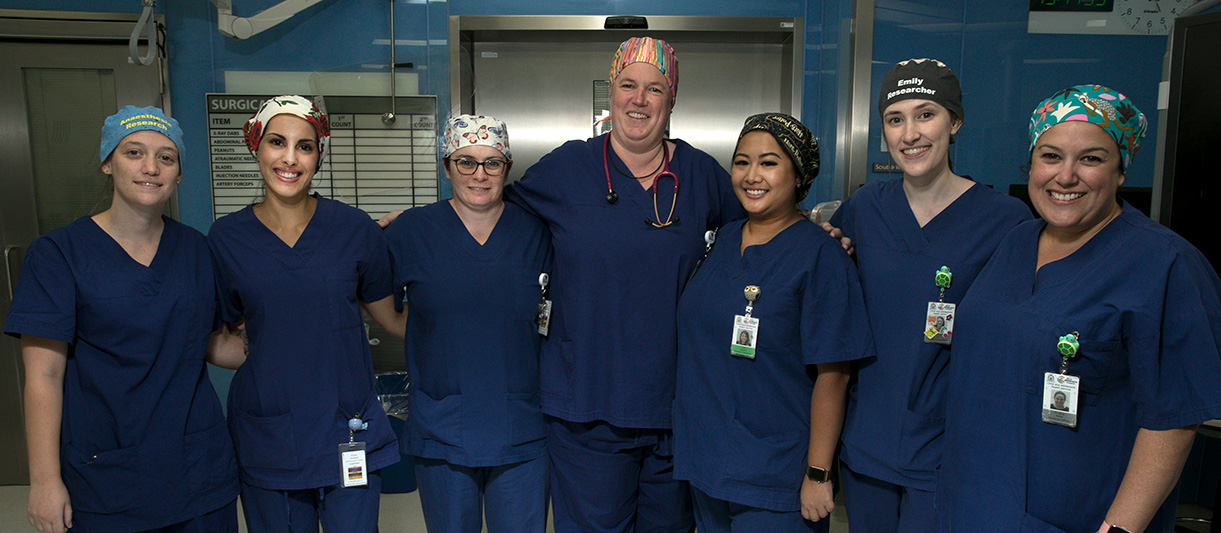
Within the hospital’s research setting, teams with varying levels of technical experience support clinical research projects.
“We employ five full-time data analysts and a dozen research assistants to make our clinical research studies happen,” Smallbone said.
While clinicians benefit from the outputs of this work—such as LLM tools for clinical research—Open OnDemand is used directly by data analysts, research assistants, and technical staff who build and maintain research workflows.
These workflows operate within the constraints of health care research across Australia, where sensitive data is often required to remain on premises. Rather than relying on large national supercomputing facilities, the team worked within a small, bespoke HPC environment designed to meet enterprise security requirements. The system includes three shared nodes—one GPU node and two CPU nodes—with network-attached storage, providing compute capacity for clinical research.
Within this system, Open OnDemand provides a secure, browser-based interface for teams to access LLM and data analysis tools. Data analysts and technical staff use it to run analyses, manage applications, and deploy research tools securely, while clinicians access the results without engaging with the technical setup.
“For our data analysts, using Open OnDemand has reduced iteration time for long-running machine learning tasks on sensitive health care data by roughly 10 times,” Smallbone said. “For clinicians, we’re able to deploy LLM chat experiences within the hospital’s secure system that have been received very well.”
That impact extended beyond individual use cases and into the team’s broader development process.
“Open OnDemand has been integral to both our development and production workflows for technical and non-technical users alike,” Smallbone said. “Without it, we would have needed to upskill users in command-line development or build a custom Slurm frontend ourselves, which would have taken months or even years.”
Making these workflows reliable required careful technical decisions, particularly around security and consistency. Existing applications were adapted where necessary so they could function smoothly within the system, with an emphasis on stability rather than technical novelty. Over time, the team found that reusing existing components helped them move faster.
“We’d emphasize the value of reusing desktops and applications from the Open OnDemand community to avoid duplicating work and to get a system up and running quickly,” Smallbone said. “For less-technical users, the desktop environment was especially important in creating something usable right away.”
In sensitive or constrained environments, Smallbone also stressed the importance of thoughtful system hardening and access control. Leveraging community-developed tools—such as Slurm plugins designed to manage network access—helped ensure shared resources could be used safely without sacrificing functionality.
By designing workflows around how people actually work, and within the realities of a sensitive research setting, the team was able to reduce friction, move more quickly, and support a broader range of users without expanding the scope or complexity of the system itself.
Smallbone’s presentation on Perth Children’s Hospital’s implementation of Open OnDemand was shared at the 2025 Global Open OnDemand (GOOD) Conference.
Written by Lexi Biasi
The Ohio Supercomputer Center (OSC) addresses the rising computational demands of academic and industrial research communities by providing a robust shared infrastructure and proven expertise in advanced modeling, simulation, and analysis. OSC empowers scientists with the services essential to making extraordinary discoveries and innovations, partners with businesses and industry to leverage computational science as a competitive force in the global knowledge economy, and leads efforts to equip the workforce with the key technology skills required for 21st-century jobs.
