
When Professor Feng (George) Yu traveled from Youngstown State University to the Ohio Supercomputer Center’s (OSC) 2026 Research Symposium, he didn’t come alone.
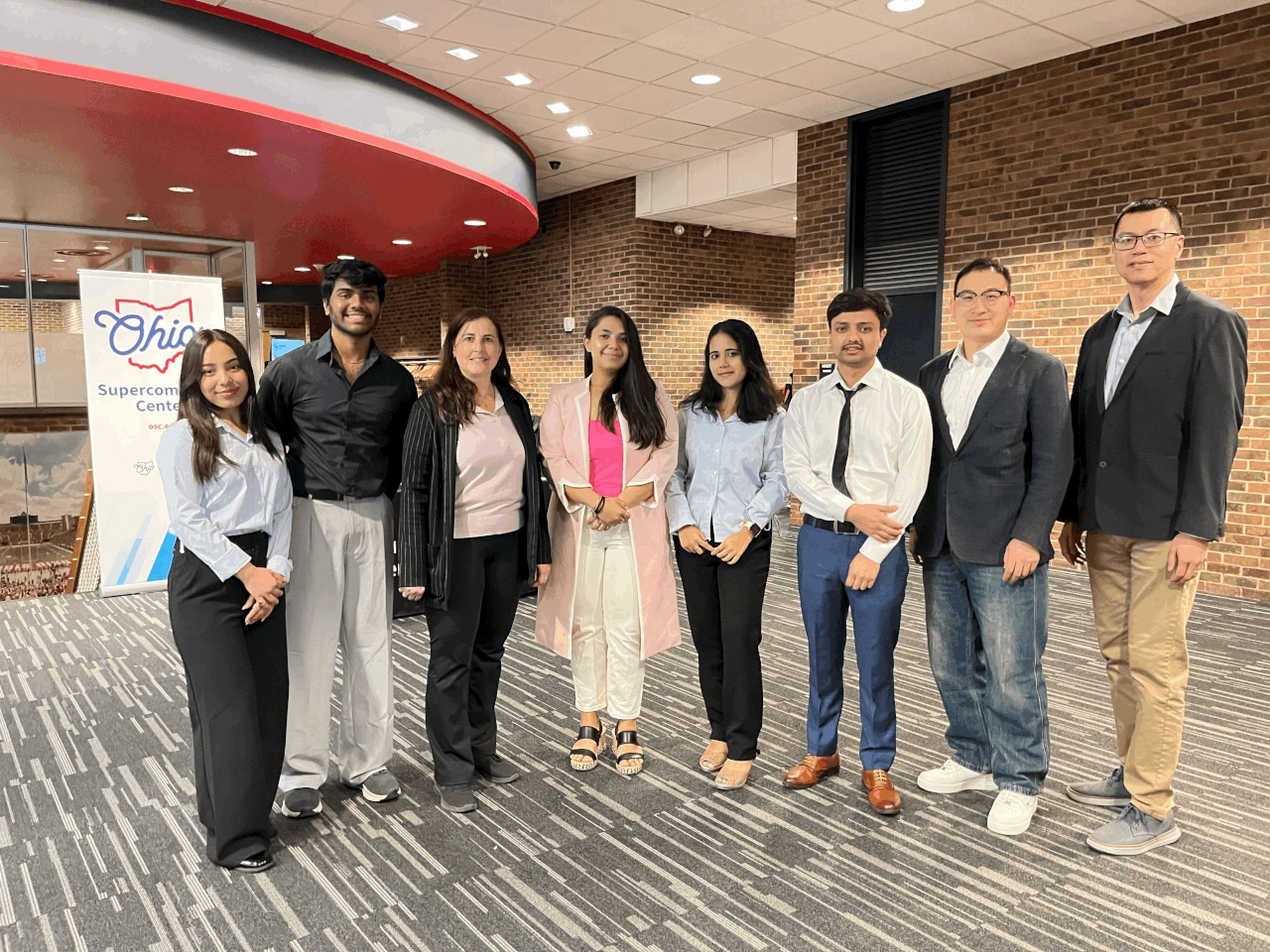
Alongside him were students eager to present research in quantum computing and blockchain technologies—projects developed with the help of OSC resources. For Yu, seeing students share their work on a statewide stage represented more than the completion of a research project. It was a glimpse into where those experiences might take them next.
As a professor in Youngstown State’s Department of Computer Science and Information Systems, Yu has made high performance computing (HPC) an integral part of both his teaching and research. Through OSC’s Open OnDemand platform, students can access powerful computing resources through a web browser, gaining hands-on experience with technologies they may never have encountered otherwise.
“When I mention that OSC resources are available to students, they are often surprised and excited,” Yu said. “Students can access resources through a web browser and Open OnDemand, which dramatically lowers the learning curve, especially for those with no prior experience in supercomputing.”
For some students, that first introduction to advanced computing becomes the foundation for future research opportunities.
One of those students is Raya Jahan, who recently completed her master of computing and information systems degree at Youngstown State.
Working alongside Yu, Jahan explored how quantum computing concepts could be used to make large-scale data analysis more efficient. Her research focused on developing methods to accelerate calculations that help researchers evaluate the accuracy of results generated from large datasets.
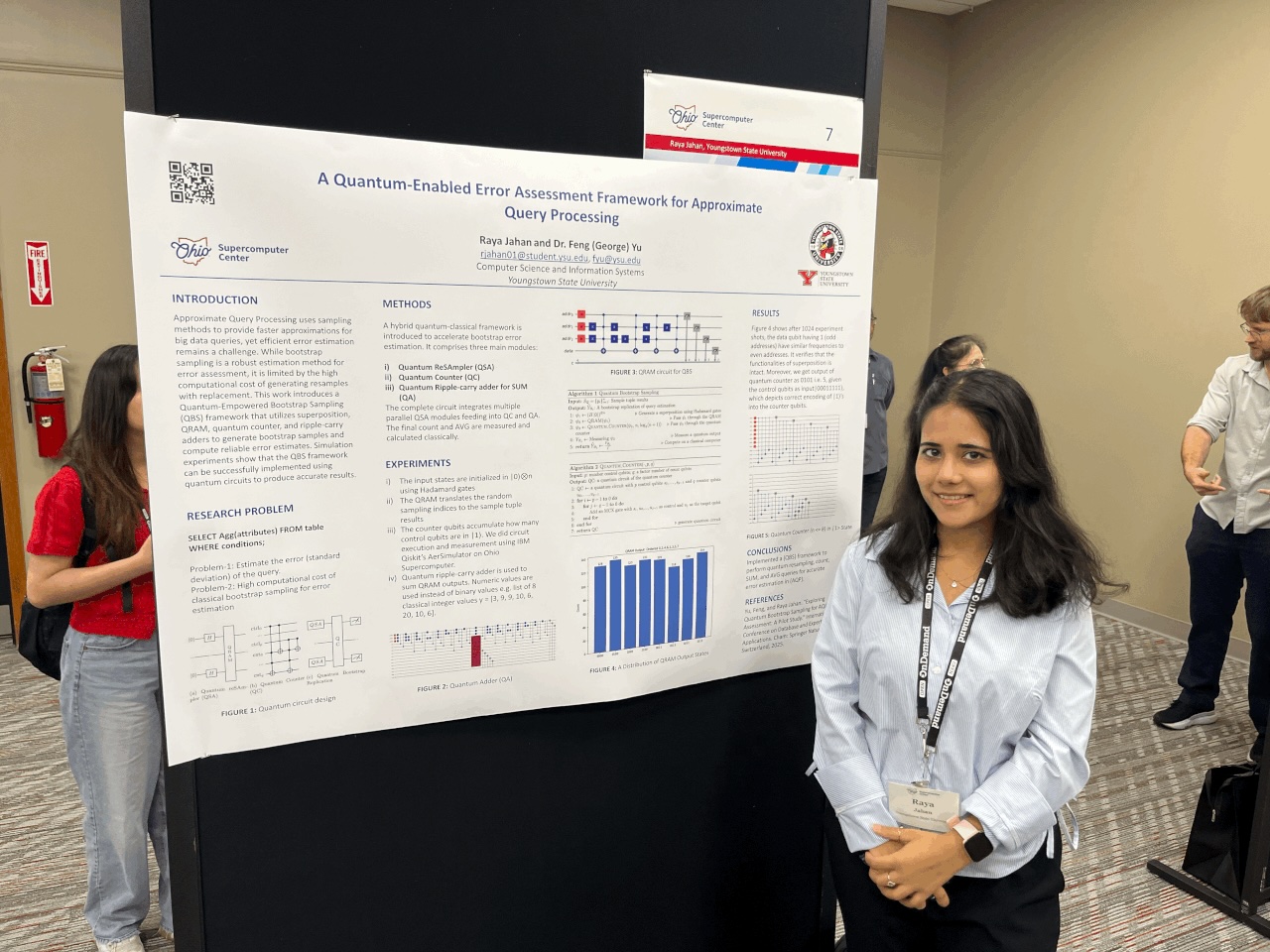
Jahan presented her project, “A Quantum-Enabled Error Assessment Framework for Approximate Query Processing,” at the 2026 OSC Research Symposium. Using OSC’s Ascend cluster, she conducted simulations of complex quantum circuits that would have been difficult to run in more traditional computing environments.
“The HPC environment enabled efficient execution of complex quantum circuit simulations, management of large-scale experiments, and faster iteration during development and testing,” Jahan said.
The project ultimately led to publication in the proceedings of the International Conference on Database and Expert Systems Applications (DEXA) 2025, providing Jahan with an opportunity to contribute to the growing field of quantum computing research.
“This experience significantly strengthened my interest in quantum computing research and motivated me to pursue a career in this field,” she said.
This fall, Jahan will continue that journey as a doctoral student in computer science at the University of Texas at Dallas.
Another student who presented alongside Yu at the Research Symposium was Prasiddha Pokhrel.
While Jahan’s work focused on quantum computing, Pokhrel tackled a different challenge: helping organizations analyze large amounts of data more quickly while protecting sensitive information.
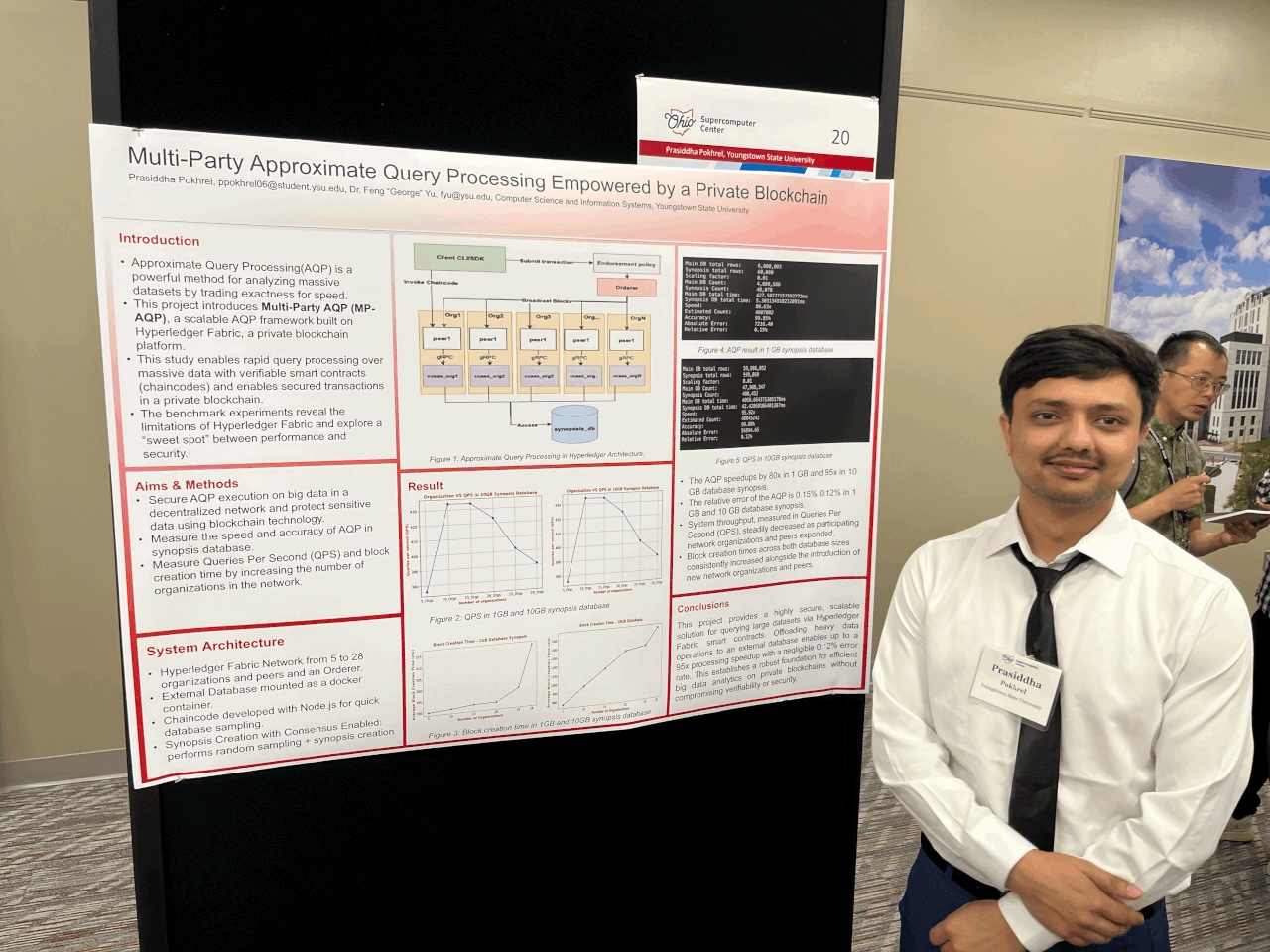
His research combined blockchain technology with advanced data analytics techniques, creating a framework designed to improve processing speed while preserving privacy. During testing, the system achieved processing speed improvements up to 95 times while maintaining a minimal error rate.
At the symposium, Pokhrel presented “Secured Approximate Query Processing Empowered by Private Blockchain,” sharing the results of his work and discussing future plans to evaluate the framework at even larger scales using OSC resources.
“OSC’s HPC power will be critical for me to push these limits and find the sweet spot between performance and security at scale,” Pokhrel said.
Like Jahan, Pokhrel sees research as a stepping stone toward future opportunities.
“This experience has shown me the massive potential at the intersection of big data analytics, secure blockchain technology, and HPC,” he said. “It has established a robust foundation for my future career goals in building efficient, secure, and verifiable distributed systems.”
After completing his degree, Pokhrel will continue his studies in Ohio as a doctoral student in computer science at Kent State University, where he will continue to have access to OSC resources.
For Yu, those student success stories are among the most rewarding outcomes of integrating advanced computing into the classroom.
The impact extends beyond graduate students.
Through summer research internships hosted by Youngstown State’s STEM College, Yu has also introduced high school students to artificial intelligence and machine learning using OSC resources.
In one recent project, students trained an AI agent to play the classic Super Mario Bros. video game using reinforcement learning techniques and GPU resources on OSC’s Cardinal cluster. Over time, the AI learned how to successfully complete the game’s first level while developing strategies that even experienced human players might not attempt.
“I have been impressed by how quickly students can begin working with OSC tools and grasp core concepts,” Yu said. “Previous cohorts learned deep learning and reinforcement learning within a few weeks and were able to independently complete small computing projects.”
Whether students are presenting research at the OSC Research Symposium, publishing scholarly work, preparing for doctoral studies, or exploring artificial intelligence for the first time, Yu sees OSC as a crucial resource for expanding what is possible in the classroom and research lab.
“Beyond technical skills, OSC broadens students’ perspectives,” Yu said. “This exposure motivates students to explore frontier technologies, challenge themselves, and plan their future careers.”
Written by Lexi Biasi
The Ohio Supercomputer Center (OSC) addresses the rising computational demands of academic and industrial research communities by providing a robust shared infrastructure and proven expertise in advanced modeling, simulation, and analysis. OSC empowers scientists with the services essential to making extraordinary discoveries and innovations, partners with businesses and industry to leverage computational science as a competitive force in the global knowledge economy, and leads efforts to equip the workforce with the key technology skills required for 21st-century jobs.
