
At Miami University, faculty can access a wealth of high performance computing (HPC) resources, from the Miami Redhawk Cluster housed at the Oxford, Ohio, institution’s campus to state-supported resources at the Ohio Supercomputer Center (OSC) and beyond.
Miami has managed and expanded the capabilities of its own Redhawk Cluster for 20 years. During that time, the HPC team led by Jens Mueller has witnessed a steady evolution of Miami faculty embracing research computing to enhance classroom lessons and to advance their research initiatives—and not only in the traditional fields of science and engineering. Faculty in disciplines such as business, economics, and finance, as well as humanities fields such as English and history, are turning to HPC to handle massive data sets that desktop computers can’t process.
“It’s a very broad spectrum of researchers. The challenge for me is to properly communicate with everyone considering their different backgrounds,” said Mueller, director of HPC services in Miami’s Office of Research and Innovation.
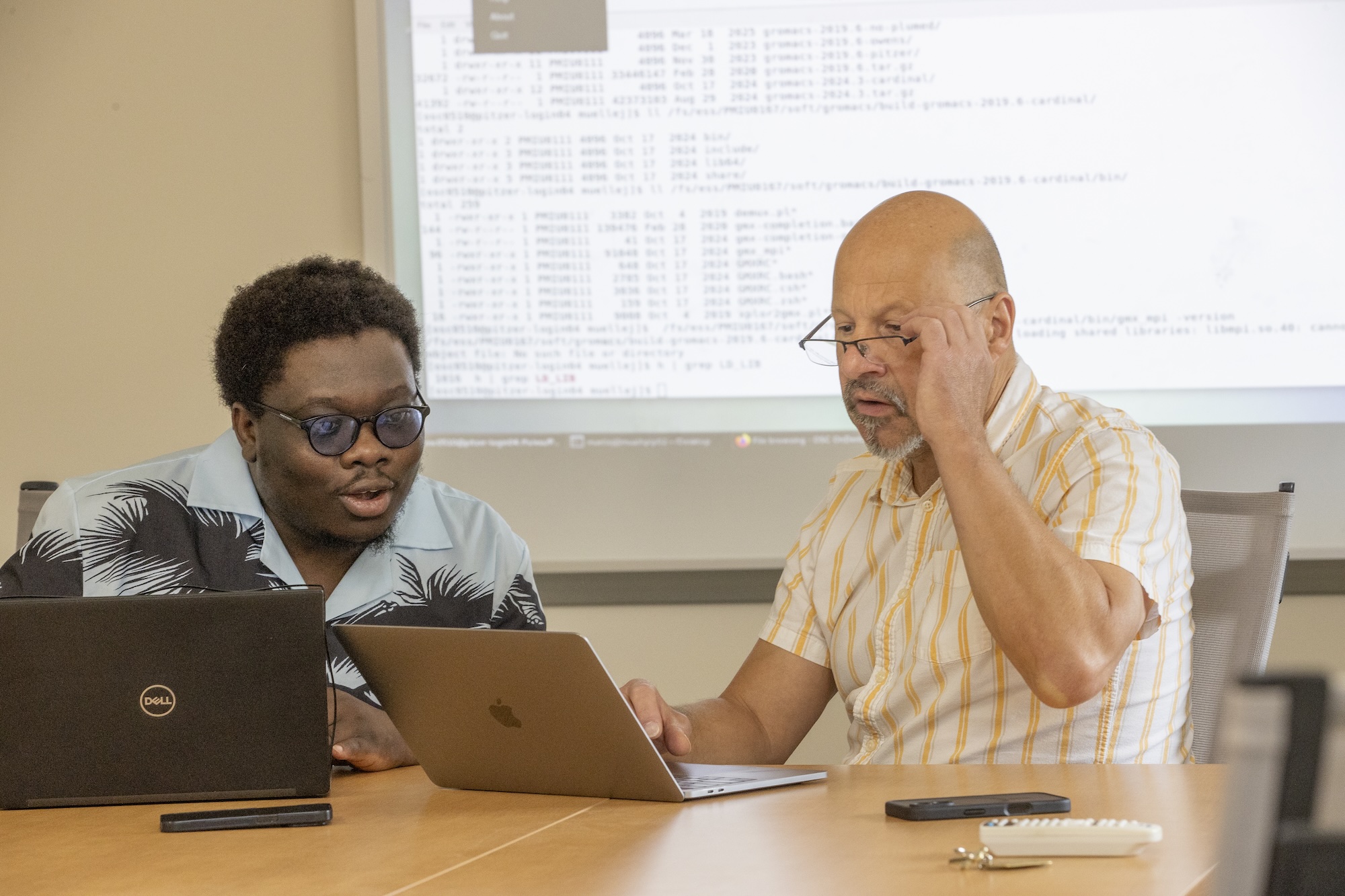
Access to HPC infrastructure alone doesn’t guarantee that faculty will have a seamless experience with using advanced computing resources for teaching or research. Mueller and his colleagues work closely with faculty to ensure they are using the correct quantity of cores or nodes and the right software for a particular project. If they use too few HPC resources, faculty may not get the results they want, Mueller said. By using too many, faculty may incur extra expenses or tie up resources that others need.
“People may think, ‘Just throw a lot of resources at me and I'll do big things,’ but a lot of thought needs to go into what type of resources are the right ones to use,” Mueller said. “You need to find the sweet spot between too few and too many resources.”
Another issue Mueller evaluates is whether faculty have HPC needs that exceed what the Miami Redhawk Cluster can accommodate. In those cases, Mueller works with faculty to acclimate them to resources at OSC, which can handle larger, more intensive computing jobs. Through his role as an OSC Campus Champion, a program that establishes and empowers an institutional liaison for faculty, Mueller trains them on how to use OSC portals such as OnDemand and may tap the expertise of OSC staff for tutorials on specialized software.
One example is Mueller’s work with Ohio Eminent Scholar and Miami Professor of Chemistry Michael Kennedy, who needed CryoSparc, a software package required for processing cryo-electron microscopy (CryoEm) data, for use in a spring 2026 special topics course. As Miami does not have the computing resources to run CryoSparc, Mueller helped Kennedy set up OSC accounts for the 13 undergraduate students and graduate student enrolled and helped them optimize their CPU usage and job queues on OSC’s computing cluster.
“In the end, all of the students and I were able to successfully use the CryoSparc software in the course,” Kennedy said. “This would not have been possible without Jens’ help and assistance. Jens came to the class three different times to help make sure that everyone had access to and could use the OSC resource. Overall, Jens provided excellent support for my course and acted as an excellent liaison for OSC resources.”
Mueller also helped Muhammad Jahan, associate professor of mechanical and manufacturing engineering, and his students transfer their computational workflows from Miami's Redhawk Cluster to a cluster at OSC. He set up group accounts and project spaces and provided access to OSC’s Abaqus license, which the research team needs to simulate and improve various steps in the process of manufacturing composites.
“My students have benefited from using OSC,” Jahan said. “I have multiple graduate students who completed their master’s degrees using the simulation results obtained by using OSC facilities.”
OSC also has provided support to Miami for a National Science Foundation (NSF) grant application and has consulted with the Miami HPC team on local hardware purchases that would be compatible with OSC’s infrastructure, Mueller said.
In addition to his work with OSC, Mueller is part of the Campus Champions program for the NSF ACCESS program, which connects researchers to dozens of major HPC resources across the United States. (OSC is also a collaborator on the NSF ACCESS program, which has helped support the further development of OSC’s Open OnDemand web portal for global HPC users.) This role allows Mueller to support faculty, graduate students, and postdoctoral fellows who are skilled at navigating HPC infrastructure but require massive computational power to achieve their research goals.
Mueller appreciates having this trio of local, state, and national resources available to offer Miami faculty and students.
“The relationship has been mutually beneficial,” Mueller said. “Miami users get access to much bigger resources and we get to tap top state expertise and support at OSC that we can benefit from.”
Written by Andrea Gibson.
The Ohio Supercomputer Center (OSC) addresses the rising computational demands of academic and industrial research communities by providing a robust shared infrastructure and proven expertise in advanced modeling, simulation, and analysis. OSC empowers scientists with the services essential to making extraordinary discoveries and innovations, partners with businesses and industry to leverage computational science as a competitive force in the global knowledge economy, and leads efforts to equip the workforce with the key technology skills required for 21st-century jobs.
