Search Documentation
Search our client documentation below, optionally filtered by one or more systems.
The LAMMPS 14May16 known issue wherein parallel lammps spawned too many threads has been fixed on all clusters. No user action is required; if a user had applied the OMP_NUM_THREADS workaround then it may be removed, but it will not cause probems if left in place. The corrected executables were made the defaults for module lammps/14may16 at these times:
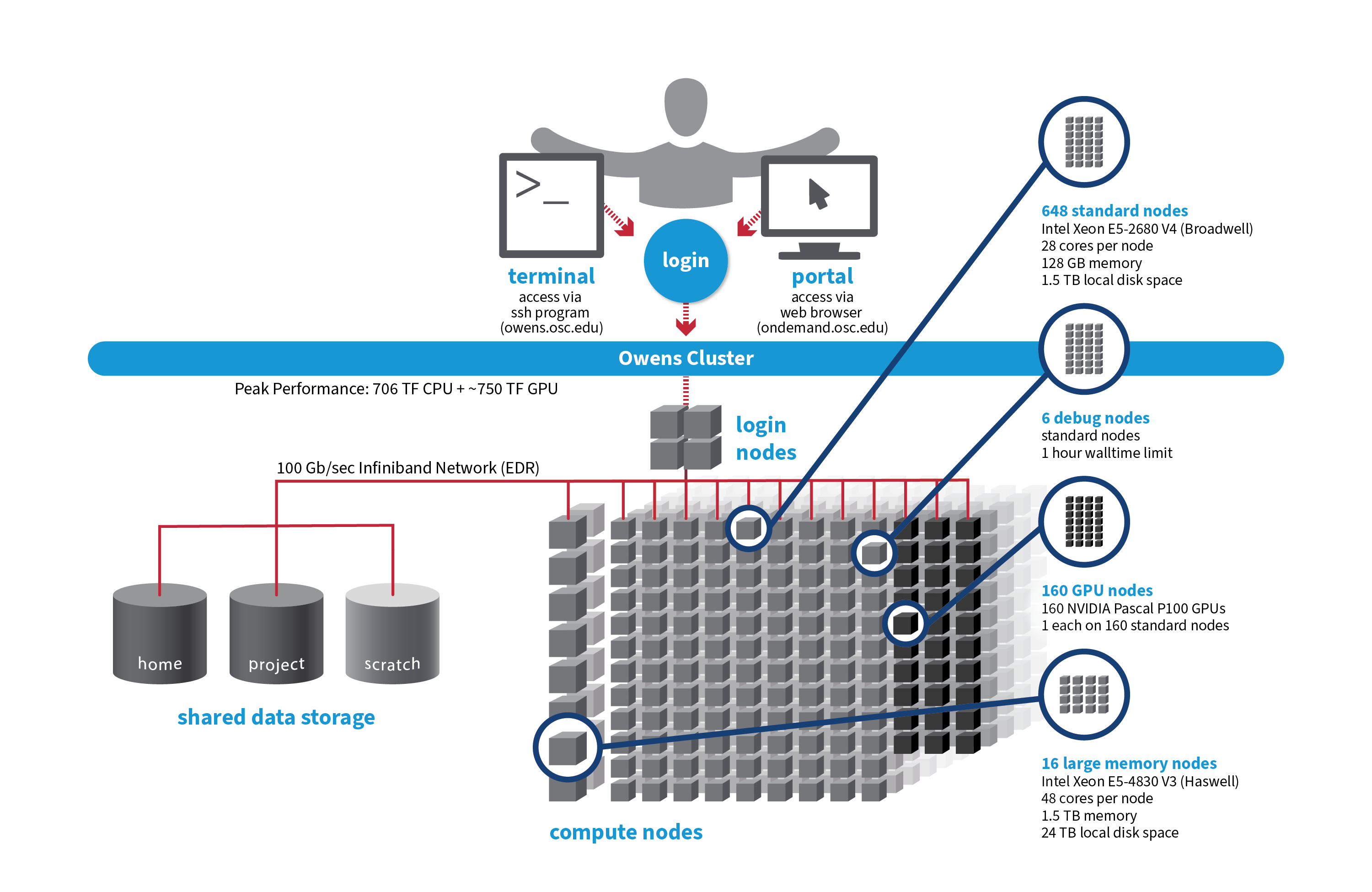
The following are technical specifications for Owens.
824 nodes
1,648 (2 sockets/node)
23,392 (28 cores/node)
28 cores/node (48 cores/node for Huge Mem Nodes)
~1,500GB in /tmp
Amber 16 has been installed on the OSC clusters; usage is via the module amber/16. For information on available executables and installation details see the software page for Amber or the output of the module help command, e.g.: module help amber/16. On August 15, 2016 Amber 16 will be made the default amber module.
C, C++ and Fortran are supported on the Owens cluster. Intel, PGI and GNU compiler suites are available. The Intel development tool chain is loaded by default. Compiler commands and recommended options for serial programs are listed in the table below. See also our compilation guide.
For more information about citations of OSC, visit https://www.osc.edu/citation.
To cite Owens, please use the following Archival Resource Key:
ark:/19495/hpc6h5b1
Please adjust this citation to fit the citation style guidelines required.
Ohio Supercomputer Center. 2016. Owens Supercomputer. Columbus, OH: Ohio Supercomputer Center. http://osc.edu/ark:19495/hpc6h5b1
Here is the citation in BibTeX format:
An eligible principal investigator (PI) heads a project account and can authorize/remove user accounts under the project account (please check our Allocations and Accounts documentation for more details). This document shows you how to identify users on a project account and check the status of each user.
OSC's Owens cluster being installed in 2016 is a Dell-built, Intel® Xeon® processor-based supercomputer.
OSC offers online and in-person training for new and advanced users on a variety of high performance supercomputing topics.
OSC has partnered with The Ohio State University to offer online training courses that clients can complete at their own pace at any time on the ScarletCanvas platform, Ohio State's public learning management system.
The available courses are:
Several commands allow you to check job status, monitor execution, collect performance statistics or even delete your job, if necessary.
There are many possible reasons for a long queue wait — read on to learn how to check job status and for more about how job scheduling works.
Use the squeue command to check the status of your jobs, including whether your job is queued or running and information about requested resources. If the job is running, you can view elapsed time and resources used.