
OSC

Since 1987, OSC has been providing our clients services in four areas, or functions:

Supercomputing. OSC provides the computational power and storage that scientists need to meet their research goals.  Whether researchers need to harness the incredible power of a parallel processor cluster to better understand deep space, a vector processor machine to do weather modeling, or a mid-size shared memory processor system to model the human heart, OSC has the hardware and software solutions to meet their needs.

Research. A staff of high performance computing and networking research experts maintain active research programs in HPC and Networking, Homeland Security and Defense, Environmental Sciences, Engineering and Life Sciences. Our goals are to lead science and engineering research efforts, assist researchers with custom needs and collaborate with regional, national and international researchers in groundbreaking initiatives.

Education. OSC has a national reputation for its training and education programs. Staff teach faculty and student researchers through scientific computing workshops, one-on-one classes, and web-based portal training. Ohio students gain exposure to the world of high performance computing and networking during our annual summer institutes for young women in middle school and for junior and senior high school students. And, the statewide, virtual Ralph Regula School of Computational Science coordinates computational science and engineering education activities for all levels of learning.

Cyberinfrastructure. The Ohio Supercomputer Center’s cyberinfrastructure and software development researchers provide the user community with various high performance computing software options. This variety enables researchers to select parallel computing languages they most prefer, and just as important, it creates a test bed for exploring these systems. By taking a holistic approach to generating efficient supercomputing applications for researchers, the Center’s cyberinfrastructure and software development research capitalizes on all the components within the cycle of innovation — development, experimentation, and analysis - and continuously improves the services provided.

Supercomputer Center, Electroscience Laboratory follow expansions with research collaboration

Last month, the Electroscience Laboratory (ESL) at The Ohio State University celebrated the groundbreaking of a new facility on Kinnear Road that will showcase the center’s unique, cutting-edge research. Just down the street, the Ohio Supercomputer Center (OSC) last summer installed a $4 million expansion to its flagship computing system, providing a huge boost to the state’s research and innovation aspirations.

Keystone Conference Promotes K-12 Internet Videoconferencing

The second annual Keystone Conference will be held October 3-5, 2005, in Indianapolis. The conference theme, "Interactive VideoConferencing: Igniting Opportunities for Learning" will bring together educators, videoconferencing leaders, content providers, and industry representatives to learn how interactive videoconferencing (IVC) technology can motivate K-12 students by igniting opportunities for learning.

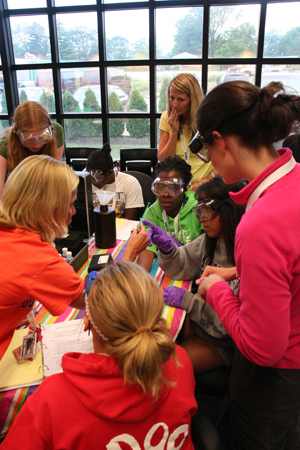
OSC Summer Camps offer skills, credit and fond memories

YWSI image

The Ohio Supercomputer Center's K-12 summer education programs — Summer Academy, Young Women's Summer Institute (YWSI) and Summer Institute (SI) — are now accepting applications for 2008.

Summer Academy in Computational Science and Engineering

New in 2008, the Summer Academy in Computational Science and Engineering is for high school students and teachers interested in learning how to use modeling and simulation in engineering design.

OCDE Conference Brings Howard Rheingold to Ohio

Howard Rheingold, one of the world's foremost authorities on the social impact of the Internet and digital technologies, will be the keynote speaker at the Ohio Commons for Digital Education 2004 - The Convergence of Libraries, Learning & Technology Conference, March 7-9 in Columbus, Ohio. On Monday, March 8, Rheingold will address the theme of the conference--the convergence of libraries, learning and technology--using his own research and unique point of view.

Pages