OSC

Since 1987, OSC has been providing our clients services in four areas, or functions:

Supercomputing. OSC provides the computational power and storage that scientists need to meet their research goals.  Whether researchers need to harness the incredible power of a parallel processor cluster to better understand deep space, a vector processor machine to do weather modeling, or a mid-size shared memory processor system to model the human heart, OSC has the hardware and software solutions to meet their needs.

Research. A staff of high performance computing and networking research experts maintain active research programs in HPC and Networking, Homeland Security and Defense, Environmental Sciences, Engineering and Life Sciences. Our goals are to lead science and engineering research efforts, assist researchers with custom needs and collaborate with regional, national and international researchers in groundbreaking initiatives.

Education. OSC has a national reputation for its training and education programs. Staff teach faculty and student researchers through scientific computing workshops, one-on-one classes, and web-based portal training. Ohio students gain exposure to the world of high performance computing and networking during our annual summer institutes for young women in middle school and for junior and senior high school students. And, the statewide, virtual Ralph Regula School of Computational Science coordinates computational science and engineering education activities for all levels of learning.

Cyberinfrastructure. The Ohio Supercomputer Center’s cyberinfrastructure and software development researchers provide the user community with various high performance computing software options. This variety enables researchers to select parallel computing languages they most prefer, and just as important, it creates a test bed for exploring these systems. By taking a holistic approach to generating efficient supercomputing applications for researchers, the Center’s cyberinfrastructure and software development research capitalizes on all the components within the cycle of innovation — development, experimentation, and analysis - and continuously improves the services provided.

The Viento Project

Ohio Supercomputer Center (OSC)

  • National Center for Atmospheric Research (NCAR)
  • NOAA Great Lakes Environmental Research Lab (GLERL)

Overall Objective

To integrate the models, people, communications and computers required to perform a coupled storm-resolving atmospheric and Great Lakes model predictions.

ACTS Experiment Objectives

To use the high data rate channel of the NASA ACTS to:

International conference features Ohio Supercomputer Center experts


Staff members at the Ohio Supercomputer Center (OSC) are being tapped for their valuable expertise to deliver numerous presentations at SC07, the International Conference for High Performance Computing, Networking, Storage and Analysis at the Reno-Sparks Convention Center in Reno, Nev., Nov. 10-16.

OSC experts will be making a series of presentations throughout the week from the center’s high-tech display booth on the exhibit floor. Among the 18 booth presentations, major topics will include:

Ohio Supercomputer Center Hosts ALTAIR Software Workshop

Learn the latest about some of the most robust engineering software packages available at the Ohio Supercomputer Center's (OSC) workshop, Using Altair HyperMesh and Hyperview.

This three day session will be held on October 16 – 18, from 9 a.m. to 5 p.m, in OSC’s BALE theater at no charge. Geared toward engineers, the workshop will cover Altair HyperWorks’ high performance, comprehensive toolbox of CAE software for engineering design and simulation.  Attendees should have a basic knowledge of finite element analysis.

UC Center Studies Ways to Design Safer Guardrails

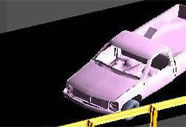
Truck ImageJust like trends in clothing, cars change their look and design rapidly with the times.

In recent years, the number of pickup trucks, passenger vans, and sport utility vehicles seen on US highways has grown substantially. Recent crash testing by the Federal Highway Administration indicates that these types of cars may be more prone to overturn when crashing into guardrails on US highways.

Pages