Research

OSC and Ohio Medical Research Centers Receive Federal Funds for Pediatric Cancer Research

The Ohio Supercomputer Center (OSC), along with three state medical centers, has received $350,000 for pediatric cancer research as part of the federal FY2004 Omnibus Appropriations bill.

This grant will be used to apply new techniques developed at the National Cancer Institute's Advanced Biomedical Computing Center (NCI-ABCC) to the study of children's diseases. Research results will accelerate the insight and understanding of cancer, leading to improved diagnostics, treatments and even new prevention options.

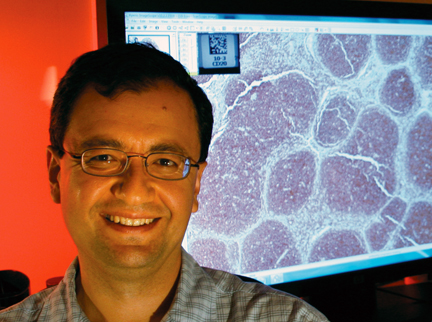
OSC, Nationwide Children's use supercomputers to speed diagnoses

Worried about her high fever and severe abdominal pain, a young couple rushed their baby daughter to the emergency department of Nationwide Children’s Hospital. Physicians there found a lump in her belly, and, after examining X-rays and blood work, confirmed the parents’ worst fear: their 18-month-old little girl had neuroblastoma, a rare pediatric cancer that involves the adrenal glands.

Ohio Supercomputer Center, Sciences Computer Consultants forge alliance to expand offerings to international clients

Logo_SCC.png

The Ohio Supercomputer Center in Columbus, Ohio, and Sciences Computers Consultants, in Saint-Etienne, France, have signed an intercontinental agreement that will expand SCC’s numerical simulation services to companies across the ocean and stateside.

Ohio Supercomputer Center Employees Published in Online Plant Physiology Journal

Four Ohio Supercomputer Center (OSC) employees, as well as two Ohio State University (OSU) plant biology researchers, had a manuscript published in the online journal, Plant Physiology. The manuscript was entitled, “Genome-wide Identification of Arabidopsis Coiled-coil Proteins and Establishment of the ARABI-COIL Database.”

OSC Aids Ohio State Chemists in Determining Nature of Ice

Chemists at The Ohio State University and their colleagues may have settled a 70-year-old scientific debate on the fundamental nature of ice.

A new statistical analysis mechanical theory has confirmed what some scientists only suspected before: that under the right conditions, molecules of water can freeze together in just the right way to form a perfect crystal. And once frozen, that ice can be manipulated by electric fields in the same way that magnets respond to magnetic fields.

Pages