
The Ohio Supercomputer Center (OSC) will host its annual Research Symposium on Wednesday, April 15, 2026, to showcase how faculty, staff, students, and industry are using high performance computing resources (HPC) to advance research, education, and innovation in a variety of fields.
Benefits of Participation
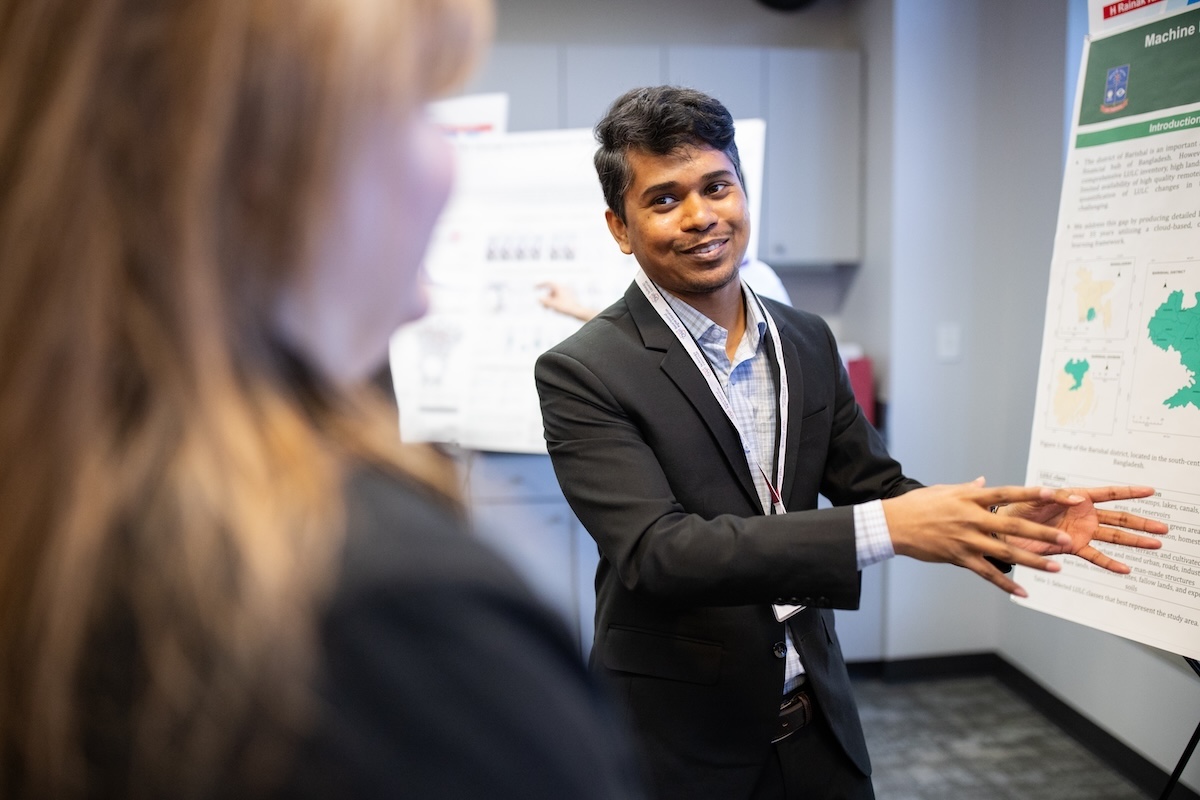
• Present posters and give short talks
• Learn about new developments in HPC
• Discuss outcomes of research and educational initiatives
• Connect with others in the HPC community
• Meet potential collaborators
• Provide valuable feedback to OSC staff
Research in Focus
Research presented at the OSC Research Symposium reflects the wide range of discoveries made possible through high performance computing. The Research in Focus video series highlights students, faculty, and researchers who have participated in the symposium and explores how they use OSC resources to tackle complex challenges across disciplines.
Explore the Research in Focus series:
- Advanced Computing Across Research Disciplines: See how researchers are using high performance computing to advance work in astrophysics, particle physics and biomedical research.
- Data-Driven Approaches to Complex Challenges: Explore research focused on optimizing computational processes, machine learning, and predicting material degradation.
- Building the Tools Behind Discovery: Learn how researchers are benchmarking GPU computing frameworks, modeling complex fluid dynamics, and developing AI tools for virus classification.
- From Secure Data Systems to Life Sciences: Discover projects ranging from blockchain-based data processing to genetic research exploring species-specific traits.
New for 2026: AI Workshop Opportunity
The OSC Research Symposium will be held in conjunction with the National Science Foundation (NSF) ACCESS Regional Workshop on artificial intelligence (AI) at the Fawcett Center on The Ohio State University’s campus.
The co-located event will allow Research Symposium participants to take advantage of a unique opportunity to attend a free workshop designed to help researchers, educators, and students learn how to integrate AI tools in research and classroom settings in a rapidly changing landscape.
The Research Symposium is free and open to all. Complimentary continental breakfast, lunch, and free parking will be offered to all presenters and in-person attendees. Virtual attendees may view the morning AI sessions and afternoon talks.
In-person registration will close at noon on Monday, April 6, 2026. Virtual registration will close at noon on Sunday, April 12, 2026. The link to join the event virtually will be sent prior to the event.
Research Symposium registration is limited to 130 attendees.
Agenda and Presenter Information
Wednesday, April 15, 2026- 9 a.m.: Check in and continental breakfast
- 9:30 a.m. - 11:30 a.m.: Morning joint AI workshop / Research Symposium content
- 9:30 - 9:45 a.m.: Intro / Overview
- 9:45 - 10:30 a.m.: Keynote, Tim Huerta, Professor of Family Medicine, CRIO & Associate Dean for Research Information Technology, Ohio State College of Medicine and Wexner Medical Center
- 10:30 - 11:30 a.m.: Education/Ethics panel, led by Basil Masri Zada, Assistant Professor of Instruction, Digital Art + Technology, Ohio University, with Josette Riep, Assistant Vice President of Integrated Data, Engineering & Application Services, University of Cincinnati, and Melinda Rhodes, Director of the Center for Teaching, Learning, and Assessment, Ohio University
- 9:30 - 9:45 a.m.: Intro / Overview
- 11:30 a.m. - 12:30 p.m.: Lunch
- 12:30 p.m. - 2 p.m.: OSC Research Symposium Poster Session
Jinsoo Ahn, The Ohio State University, An imprinting gene cluster at the porcine CRSP complex locus defines a species-specific imprinted domain
Bipana Bista, Youngstown State University, Scalable Metric Learning for Particle Tracking: A Distributed Data Parallelism Study of Hit Embedding
Shreeshtee Dhakal, Youngstown State University, Benchmarking Deep Learning Architectures for ECG Classification Using Ohio Supercomputer Center HPC Resources
Daniel Egbuzie, The Ohio State University, Uncertainty-Aware Prediction of Environmentally Assisted Crack Growth Using Machine Learning
Andrew Engel, The Ohio State University, Towards Uncertainty Quantification with Continuous Piecewise Linear Networks
Ikramul Hasan, The Ohio State University, Approximate Bayesian Spatiotemporal Deep Learning Model for Reliable Mapping of Mining-Induced LULC Dynamics
Raya Jahan, Youngstown State University, A Quantum-Enabled Error Assessment Framework for Approximate Query Processing
Hailong Jiang, Youngstown State University, LLM-Guided Reasoning for Compiler Intermediate Representation Optimization
Rohith Krishnan Sudha, The Ohio State University, Benchmarking Modern GPU Computing Frameworks for the Efficient Extraction of Flow Acoustics
Eugene Lee, University of Cincinnati, Learning to Select Visual In-Context Demonstrations
Junhao Liu, The Ohio State University, Mapping Differential RNA Editing Regions in 3′UTRs from Lung Cancer to Pan-Cancer Analysis
Youwei Liu, The Ohio State University, Catch the ghost! Neutrino simulation for RNO-G detector in Greenland
Amelia McLaren, Indiana Biosciences Research Institute, Human Transferrin Receptor Bispecific TREM2 Antibody Creation and Its Insightful Use in Alzheimer’s Disease
Aaron Meade, The Ohio State University, Reconstruction of Simulated ANITA III Neutrino Events Using Convolutional Neural Networks
Nebiyou Mengistu, The College of Wooster, Machine Learning for Predicting Maximum Proton Energy in Laser-Proton Acceleration Experiments
Shelby Moshier, The Ohio State University, Not too hot, not too cold: developing an adaptive cooling schedule for PICL
Sultana Nahar, The Ohio State University, Simulated Multi-wavelengths Spectra of Fe-peak Elements, Ti, Cr, Mn, for Astrophysical Line Diagnostics and modeling
Seungyeon Oh, The Ohio State University, Accelerating RL-based Optimal Control Via HPC
Ahmed Paridie, PE, Utilizing OSC for a Theoretical Framework for Particles-Fluid Interactions
Prasiddha Pokhrel, Youngstown State University, Secured Approximate Query Processing Empowered by Private Blockchain
H Rainak Khan Real, The Ohio State University, Deep Learning-based monitoring of seasonal forest dynamics and fragmentation in Chittagong Hill Tracts of Bangladesh
James Riddell, The Ohio State University, ClassyVir: A Multimodal AI Platform for Virus Taxonomy From Realm to Species
Zoe Riesen, The Ohio State University, Machine Learning Analysis for Neutrino Event Reconstruction
José Sanabria-Gracia, The Ohio State University, From Synthetic Complexes to Metalloenzymes: DFT Bridging Theory and Experiment in Transition Metal Chemistry
Keval Bharatbhai Suthar, The University of Toledo, Thermophysical and Surface Property-Driven Machine Learning for Critical Heat Flux Prediction in Pool Boiling
Sree Sai Charan Vaitla, Youngstown State University, Scaling AI-Based Particle Track Reconstruction with High-Performance Computing on the TrackML Dataset
Mingyi Xu, The Ohio State University, [O III] line ratios and evolution of oxygen abundance with redshift using JWST-VLT-Keck observations
- 2 p.m. - 3:30 p.m.: OSC Research Symposium Brief Bytes (short talks)
Umar Islambekov, Bowling Green State University, TDAvec: An R Package for Computing Vector Summaries of Persistence Diagrams for Topological Data Analysis
Godstand Aimiuwu, The Ohio State University, Scalable Manufacturing of CsPbBr3 Perovskite Nanoparticle Using Jet Mixing Reactor With Inline Spectroscopic Measurements
Aaron Sathyanesan, University of Dayton, An AI/ML approach enables precise identification of cerebellar deficits in mouse models of neurodevelopmental disorders
Hwihyeon Kang, The Ohio State University, Optimizing Semiconductor Bloch Equation Solvers Using Artificial Intelligence
Ziyang Song, Ohio University, Build Trustworthy Large Language Models in Healthcare Through Expert Knowledge
Dominic Wilson, University of Findlay, Scaling AI Security Pedagogy: From Local Labs to HPC-Enabled Red Teaming
- 3:30 p.m. - 3:45 p.m.: Break
- 3:45 p.m. - 5:15 p.m.: OSC Research Symposium Brief Bytes (short talks)
Abdul Rehman Akbar, The Ohio State University, Deep Learning on Routine Histopathology Enables One-Year Survival Prediction in Pancreatic Ductal Adenocarcinoma
Patrick Collins, The Ohio State University, Teaching molecular immunology graduate students computational analysis with web assembly to bridge learning gaps
Zhongning Deng, The Ohio State University, Classifying Transposable Elements with Deep Learning
Joyce Lee, The Ohio State University, Most Important Predictors of Father-Child Contact in the U.S. Child Welfare System: Random Forest Modeling
Christoph Weigel, The Ohio State University, Profiling human DNA methylomes reveals epigenetic layouts of human herpesvirus-6 as a viral disease biomarker
Divya Chari, The Ohio State University, Temperature-density effects on atomic cross sections in high-energy-density plasmas
Proposal submission guidelines
What topics can be submitted?
Anything related to computational science, including (but not limited to):
- Domain-specific research project approaches and results
- Usage details of OSC or non-OSC research computing resources
- Research computing training, education, or workforce development
- Software development
What presentation formats are allowed?
- Proposals for five- to 10-minute talks, in person only.
- Poster presentations for an in-person poster session at the event. Accepted posters can be printed in-house at OSC, if file provided by April 1.
- If you would like to present in a different format, please indicate your interest on the submission form. OSC staff will review and respond to your request.
Who can submit?
- Students, researchers, clinicians, faculty, staff, industry partners
- Academic, nonprofit, and government institutions, private sector organizations
How to submit
Please submit your Research Symposium proposals through our presentation portal. Submissions are due prior to 11:59 p.m. (EST) on Sunday, March 8, 2026. Notifications of acceptance will be sent by Monday, March 16, 2026.
All presented research will be curated into a comprehensive set of published proceedings. This document will ensure credibility and visibility among peers, institutions and industry professionals, opening doors for networking and collaboration opportunities.
View the list of 2025 presentations and 2024 list of presentations in our archives.
