
OSC

Since 1987, OSC has been providing our clients services in four areas, or functions:

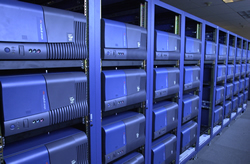
Supercomputing. OSC provides the computational power and storage that scientists need to meet their research goals.  Whether researchers need to harness the incredible power of a parallel processor cluster to better understand deep space, a vector processor machine to do weather modeling, or a mid-size shared memory processor system to model the human heart, OSC has the hardware and software solutions to meet their needs.

Research. A staff of high performance computing and networking research experts maintain active research programs in HPC and Networking, Homeland Security and Defense, Environmental Sciences, Engineering and Life Sciences. Our goals are to lead science and engineering research efforts, assist researchers with custom needs and collaborate with regional, national and international researchers in groundbreaking initiatives.

Education. OSC has a national reputation for its training and education programs. Staff teach faculty and student researchers through scientific computing workshops, one-on-one classes, and web-based portal training. Ohio students gain exposure to the world of high performance computing and networking during our annual summer institutes for young women in middle school and for junior and senior high school students. And, the statewide, virtual Ralph Regula School of Computational Science coordinates computational science and engineering education activities for all levels of learning.

Cyberinfrastructure. The Ohio Supercomputer Center’s cyberinfrastructure and software development researchers provide the user community with various high performance computing software options. This variety enables researchers to select parallel computing languages they most prefer, and just as important, it creates a test bed for exploring these systems. By taking a holistic approach to generating efficient supercomputing applications for researchers, the Center’s cyberinfrastructure and software development research capitalizes on all the components within the cycle of innovation — development, experimentation, and analysis - and continuously improves the services provided.

Path Finding: Behavior of Artificial Neural Network

Abstract

To travel from one location to another is a common task for most human beings. Actually creating a robot to find a path to the destination while avoiding obstacles is another task. The behavior of an artificial neural network is synthesized mimicking the decisions leading to a path. a two-layer network using a simplified model of a biological network (i.e. brain is used).
Bring Your Science to Life

Cleveland State University faculty soon will learn new ways to transform their data into visualizations to give themselves, colleagues and students a better understanding of their research with the help of a two-day workshop offered by the CSU Dept. of Chemistry and the Ohio Supercomputer Center (OSC).

Register now for SC07/Ohio Supercomputer Center workshop on integrating computational science into curricula

Both businesses and researchers increasingly are using computational science to enhance their return on investments and discovery methods. Faculty wishing to incorporate this discipline into their coursework are invited to attend the workshop, “Integrating Computational Science into the Undergraduate Curriculum,” June 17 to 23, 2007, at the Ohio Supercomputer Center, Columbus, Ohio.

OSC, partners receive portion of multi-million dollar Defense contract, to provide high performance computing solutions for DoD suppliers

In collaboration with the University of Southern California's Information Sciences Institute, who was awarded a Defense Advanced Research Projects Agency (DARPA) contract, the Ohio Supercomputer Center will help demonstrate the benefits of high performance computing, defense-critical modeling and simulation solutions for the Department of Defense supply chain.

The First Annual OSC Graduate Student Workshop/Conference!

The High Performance Computing (HPC) division of OSC is sponsoring a Graduate Student Conference/Workshop at OSC on August 11 and 12, 2000. The purpose of the Conference/Workshop is to introduce graduate students from around the state to the resources and capabilities of OSC, as well as to exchange information about research projects being undertaken by other graduate students in Ohio.

OSC Announces YWSI 2001 Middle School Participants

OSC (Ohio Supercomputer Center) has announced that 15 middle school girls have been selected to participate in its Young Women's Summer Institute (YWSI).

This is OSC's second year offering the YWSI Program. YWSI is specially designed for Ohio's middle school girls as a response to the low participation of women in the fields of science and technology. YWSI gives the girls an opportunity to work with OSC's most advanced supercomputers with the aid and instruction of top professionals.

Distributed Memory MIMD Programming and Operating Environment for Heterogeneous UNIX Computers on a Network

Software development specialists at the Ohio Supercomputer Center have released Local Area Multiprocessor (LAM) to the parallel processing and cluster computing community. LAM has been ported to several leading UNIX machines such as Sun, SGI, RS/6000, DEC APX and to Cray running UNICOS. LAM is freely available under a GNU license via anonymous ftp from tbag.osc.edu or from gopher at gopher.osc.edu. URL is gopher: //gopher.osc.edu:70/Software/Trollius.

Pages